 First Whistle Hockey
Rules explained
Why Your 8U Plays Cross-Ice
Why 8U hockey is played cross-ice, explained for parents. USA Hockey's 8U model splits the rink into small surfaces so every player gets far more puck touches, uses a lighter blue puck, and has kids take turns in goal instead of using a full-time goalie.
- AgesAll ages
- RulebookUSA Hockey
- WhereFull rink
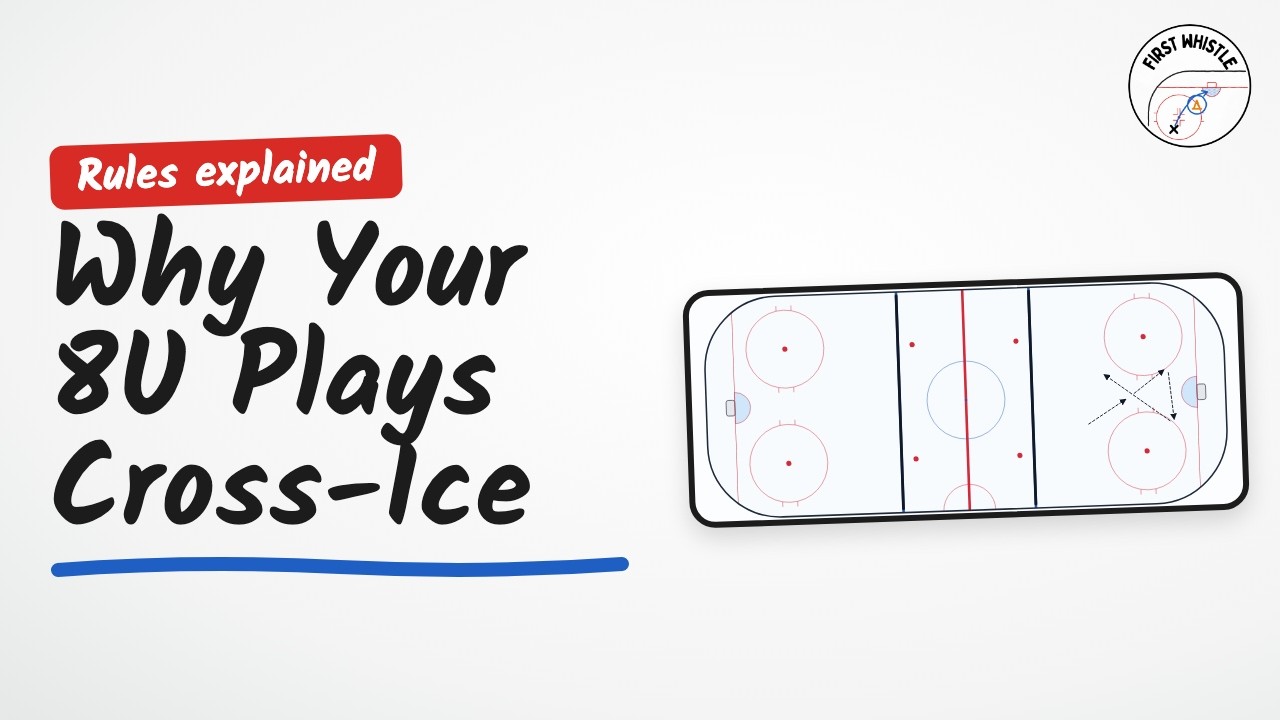 Watch on YouTube · 1:15 (opens YouTube in a new tab)
- Barrier
- Pass
The rule
- 8U games are played cross-ice or half-ice, not full-ice.
- Smaller ice means more puck touches for every player.
- 8U uses a lighter blue puck. It's required at 8U.
- There are no full-time goalies at 8U. Kids take turns.
How to see it
- Dividers split the rink into smaller game areas.
- Games run sideways across the rink.
- Practices rotate through stations every 7 to 8 minutes.
- Skills and small-area games come before team systems.
Tell your players
- Small ice means more puck. Go get it.
- Try every position, including goalie.
- Keep your head up in tight spaces.
- Compete for every puck.
Common mix-ups
- Cross-ice isn't real hockey.
- Actually: It's USA Hockey's standard 8U game, built for more puck touches.
- My kid needs full ice to get better.
- Actually: One study USA Hockey points to found young players had the puck for only about 20 seconds in a full-ice game.
- 8U should run team systems.
- Actually: The 8U model puts skills and small-area play first.
- The blue puck is just for fun.
- Actually: It's lighter, and it's required at 8U.
By age and league
- 8U: cross-ice or half-ice games, blue puck, no full-time goalies.
- 10U: the blue puck is strongly recommended, and some areas require some half-ice games.
- Some areas allow a few full-ice 8U games. Check your league.
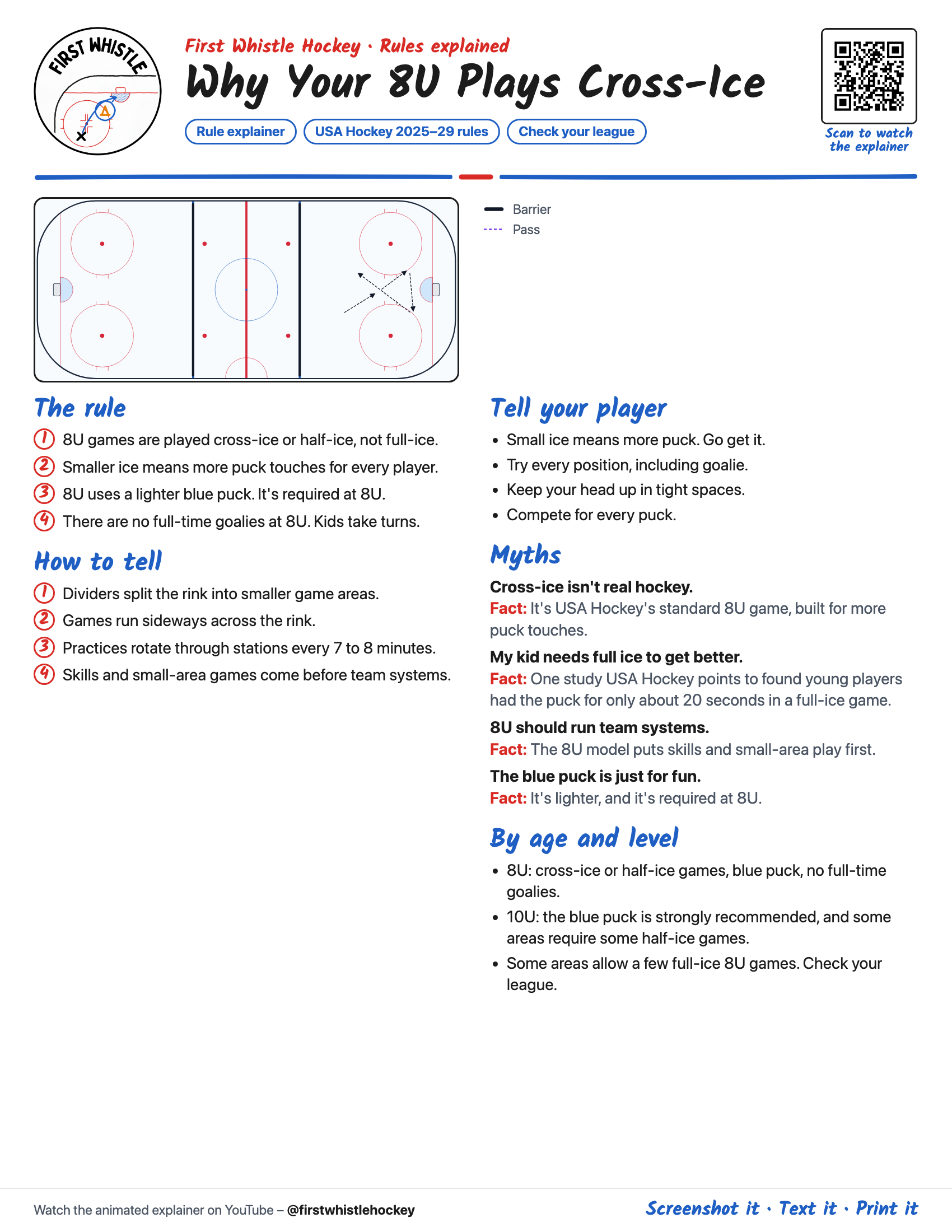
Printable rule sheet
One page, US Letter. Print it for the rink, or save it to your phone and text it to your coaches.
Download the cardVideo transcript
Intro
Your 8U player's game is on a third of the rink, played sideways. That's on purpose. Here's why.
Cross-ice
Most 8U games are played cross-ice or half-ice. Dividers split the rink into smaller sections, and each game runs sideways across one of them.
More puck touches
Smaller ice means more puck touches. One study USA Hockey points to found that in a full-ice game, a young player had the puck for only about twenty seconds. On a small surface, the puck finds everyone.
The blue puck
8U also plays with a lighter blue puck. It's required at 8U, and USA Hockey strongly recommends it at 10U.
Everyone tries goalie
And there are no full-time goalies at 8U. Kids take turns in net, and the focus is skills, not set positions.
Station practices
Practices work the same way. Kids rotate through small stations, usually every seven or eight minutes.
So tell your player: small ice means more puck, so go get it. Some areas allow a few full-ice 8U games, so check your league, and grab the rule sheet in the description.
Summarized in our own words from USA Hockey's American Development Model (8U parent guide) and Official Rules (Rule 306). Leagues and areas can differ, so check yours.
New drills in your inbox
Get new drills, practice plans and printable cards by email. Free, for coaches and parents. Unsubscribe anytime.
First Whistle Hockey (Red Rock Apps LLC) will email you new drills, practice plans and, now and then, news about things we make. We'll send a confirmation email first. Every email has an unsubscribe link. Questions: [email protected]. See privacy.
More rules

Contact vs. Checking: When Does Hitting Start?
Rules explained

The Delayed Penalty: Why Our Goalie Skated Off
Rules explained

Faceoffs: Who Stands Where and Why It Matters
Rules explained

Goals That Don't Count (Youth vs. NHL)
Rules explained

Icing: Why the Whistle Blew (and Why There's No Race)
Rules explained

Line Changes: Why Kids Sprint to the Bench
Rules explained

Offside: Watch the Skates, Not the Stick
Rules explained

Penalties 101: Why Is My Kid in the Box, and for How Long?
Rules explained

Respect the Stripes: Zero Tolerance for Players, Coaches and Parents
Rules explained
 Coming soon
Girls' vs Boys' Hockey: What's Different?
Rules explained · Coming soon · Nov 24