 First Whistle Hockey
Rules explained
Girls' vs Boys' Hockey: What's Different?
What's different between girls' and boys' hockey, explained for parents. In USA Hockey and Hockey Canada there's no body checking in girls' hockey at any age, but contact like puck battles and angling is legal. The rule follows the team, so a girl on a co-ed 14U checking team can be checked. Penalties, offside, icing and youth gear are the same. US girls finish at 19U instead of 18U.
- AgesAll ages
- RulebookUSA & Canada
- WhereCenter ice to the attacking zone
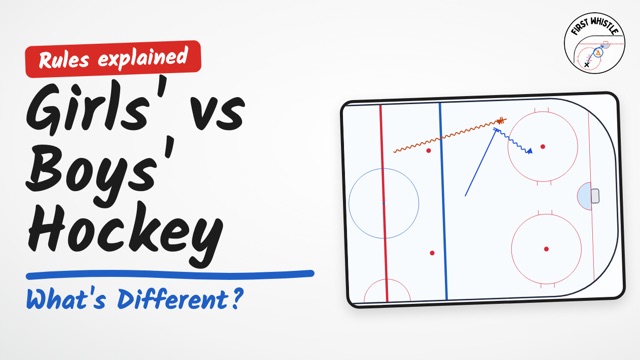
The rule
- No body checking in girls' or women's hockey at any age, adults included.
- Boys' and co-ed teams can add checking at 14U (USA Hockey) or U15 (Hockey Canada), unless the league bans it.
- Contact is still legal: puck battles, holding your position and angling.
- The rule follows the team. A girl on a co-ed 14U+ checking team plays by that team's rules.
How to see it
- A body check in girls' hockey is a minor, or a major and a game misconduct if it's reckless.
- When a girls' team plays a checking team, the game is non-checking (USA Hockey).
- Same penalties, same offside and icing, same required youth gear.
- US girls finish at 19U, a three-year group. Youth ends at 18U.
Tell your players
- Play the puck, not the player.
- Angle the carrier toward the boards with your stick on the puck.
- Lean in on puck battles. Don't launch.
- Keep your head up.
Common mix-ups
- No checking means no contact.
- Actually: Puck battles, body position and angling are legal at every age.
- Girls never get checked.
- Actually: A girl on a co-ed 14U+ checking team plays that team's rules, checking included.
- Girls' hockey has its own rulebook.
- Actually: It's the same rulebook. Body checking is the only playing rule that changes.
- No checking means no concussions.
- Actually: Heads-up play still matters at every level.
By age and league
- Girls' hockey, every age: no body checking.
- Co-ed youth 12U and under: no body checking.
- Co-ed youth 14U+ (U15+ in Canada): checking, unless the league bans it. Girls on those teams included.
- College women: no checking. Pro (PWHL) and international: a puck-focused form of checking.
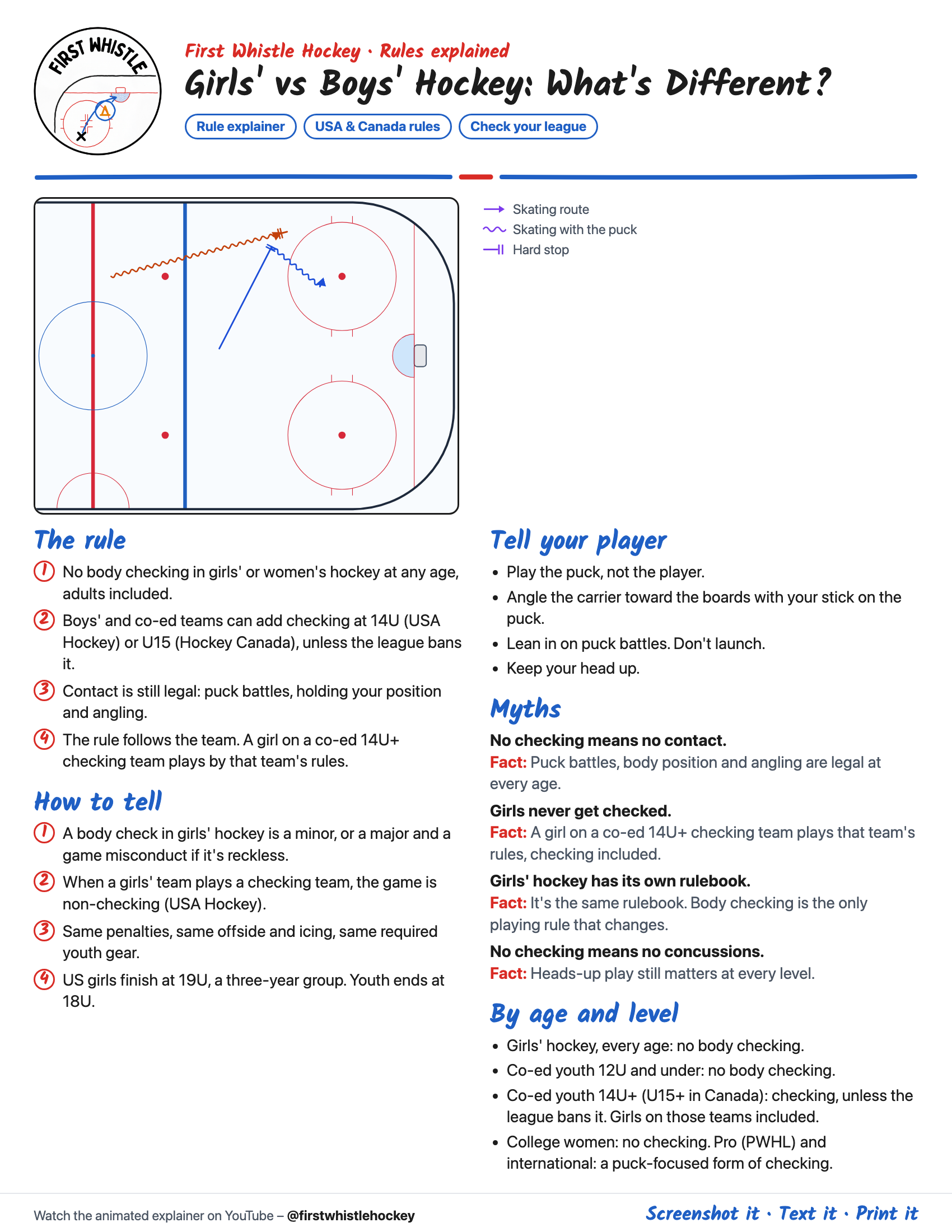
Printable rule sheet
One page, US Letter. Print it for the rink, or save it to your phone and text it to your coaches.
Download the cardVideo transcript
Intro
Girls' hockey and boys' hockey use the same rulebook. There's really just one big difference, and one exception most people miss.
The one big difference
In USA Hockey and Hockey Canada, there's no body checking in girls' or women's hockey. Not at any age, adults included. On boys' and co-ed teams, checking can start at 14U in the US, or U15 in Canada, if the league allows it.
Contact that's legal
But no checking doesn't mean no contact. Players can lean into each other going for the puck, hold their position, and angle the puck carrier toward the boards. Think position, not propulsion.
What a check costs
A body check is using your hip, shoulder or body to knock a player off the puck. In girls' hockey, that's a minor penalty, or a major and a game misconduct if it's reckless. In Hockey Canada, if the check injures someone, it's automatically a major.
The exception
Here's the part most people miss. The rule follows the team, not the player. In USA Hockey, a girl on a co-ed 14U checking team plays by that team's rules, and that includes checking. And when a girls' team plays a checking team, the game is non-checking.
Everything else is the same
Apart from checking, it's the same game. Same penalties, same offside and icing. Youth girls wear the same required gear as boys: a certified helmet, full cage and neck guard, plus a mouthguard from 12U in USA Hockey. The age groups match too, right up to the top. US girls finish at 19U, a three-year group, while youth hockey ends at 18U.
At the top level
At the top level, it changes again. College women's hockey still bans checking. But the PWHL and international women's hockey allow a puck-focused form of body checking. So the contact skills girls learn young are the ones they'll use all the way up.
So, no checking in girls' hockey, but plenty of contact. Teach angling, body position and heads-up play. Check your league's rules, and grab the rule sheet in the description.
Rules summarized in our own words from USA Hockey's 2025–29 Official Rules (Rule 604, Glossary and Preface), the USA Hockey 2026–27 Annual Guide and Hockey Canada's 2026–28 Playing Rules (Rule 7.3). Leagues can differ, so check yours.
New drills in your inbox
Get new drills, practice plans and printable cards by email. Free, for coaches and parents. Unsubscribe anytime.
First Whistle Hockey (Red Rock Apps LLC) will email you new drills, practice plans and, now and then, news about things we make. We'll send a confirmation email first. Every email has an unsubscribe link. Questions: [email protected]. See privacy.
More rules

Why Your 8U Plays Cross-Ice
Rules explained

Contact vs. Checking: When Does Hitting Start?
Rules explained

The Delayed Penalty: Why Our Goalie Skated Off
Rules explained

Faceoffs: Who Stands Where and Why It Matters
Rules explained

Goals That Don't Count (Youth vs. NHL)
Rules explained

Icing: Why the Whistle Blew (and Why There's No Race)
Rules explained

Line Changes: Why Kids Sprint to the Bench
Rules explained

Offside: Watch the Skates, Not the Stick
Rules explained

Penalties 101: Why Is My Kid in the Box, and for How Long?
Rules explained

Respect the Stripes: Zero Tolerance for Players, Coaches and Parents
Rules explained