 First Whistle Hockey
Rules explained
Contact vs. Checking: When Does Hitting Start?
When body checking starts in USA Hockey, explained for parents and players. No body checking at 12U and younger or in girls' hockey at any age. Checking starts at 14U for boys and youth teams, unless the league bans it. Competitive contact and angling are legal at every age, and head contact and hits from behind are always penalties.
- AgesAll ages
- RulebookUSA Hockey
- WhereCenter ice to the attacking zone
 Watch on YouTube · 1:20 (opens YouTube in a new tab)
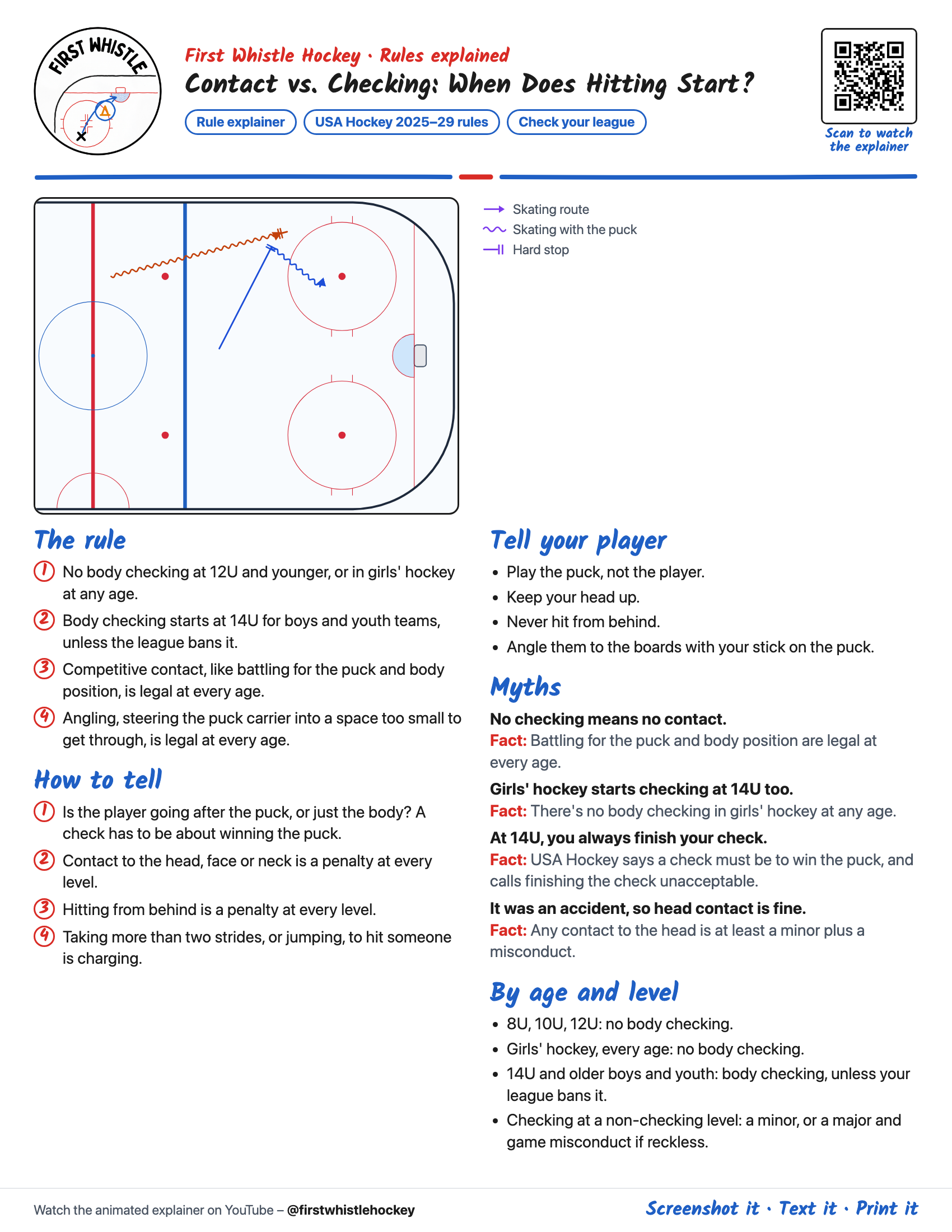
The rule
- No body checking at 12U and younger, or in girls' hockey at any age.
- Body checking starts at 14U for boys and youth teams, unless the league bans it.
- Competitive contact, like battling for the puck and body position, is legal at every age.
- Angling, steering the puck carrier into a space too small to get through, is legal at every age.
How to see it
- Is the player going after the puck, or just the body? A check has to be about winning the puck.
- Contact to the head, face or neck is a penalty at every level.
- Hitting from behind is a penalty at every level.
- Taking more than two strides, or jumping, to hit someone is charging.
Tell your players
- Play the puck, not the player.
- Keep your head up.
- Never hit from behind.
- Angle them to the boards with your stick on the puck.
Common mix-ups
- No checking means no contact.
- Actually: Battling for the puck and body position are legal at every age.
- Girls' hockey starts checking at 14U too.
- Actually: There's no body checking in girls' hockey at any age.
- At 14U, you always finish your check.
- Actually: USA Hockey says a check must be to win the puck, and calls finishing the check unacceptable.
- It was an accident, so head contact is fine.
- Actually: Any contact to the head is at least a minor plus a misconduct.
By age and league
- 8U, 10U, 12U: no body checking.
- Girls' hockey, every age: no body checking.
- 14U and older boys and youth: body checking, unless your league bans it.
- Checking at a non-checking level: a minor, or a major and game misconduct if reckless.
Printable rule sheet
One page, US Letter. Print it for the rink, or save it to your phone and text it to your coaches.
Download the cardVideo transcript
Intro
Hockey is a contact sport, so when does hitting actually start? Here's the rule.
When checking starts
In USA Hockey, there's no body checking at 12U and younger, and none in girls' hockey at any age. Body checking starts at 14U for boys and youth teams. And even then, many house leagues don't allow it.
Contact that's legal
No checking doesn't mean no contact. Players can still battle for the puck and use their bodies to get position. And angling, steering the puck carrier into a space too small to get through, is legal at every age.
A check at a non-checking level
A body check is different. It's using your hip, shoulder or body to knock a player off the puck. At a non-checking level, that's a penalty. A minor, or a major and a game misconduct if it's reckless.
Penalties at every level
At checking levels, a check has to be about winning the puck. And some hits are penalties at every level: any contact to the head, hits from behind, late hits after the puck is gone, and charging, which is taking more than two strides or jumping into a hit.
So tell your player: play the puck, keep your head up, and never hit from behind. Check your league's rules, and grab the rule sheet in the description.
Rules summarized in our own words from USA Hockey's 2025–29 Official Rules (Rule 604 and related rules). Leagues and tournaments can differ, so check yours.
New drills in your inbox
Get new drills, practice plans and printable cards by email. Free, for coaches and parents. Unsubscribe anytime.
First Whistle Hockey (Red Rock Apps LLC) will email you new drills, practice plans and, now and then, news about things we make. We'll send a confirmation email first. Every email has an unsubscribe link. Questions: [email protected]. See privacy.
More rules

Why Your 8U Plays Cross-Ice
Rules explained

The Delayed Penalty: Why Our Goalie Skated Off
Rules explained

Faceoffs: Who Stands Where and Why It Matters
Rules explained

Goals That Don't Count (Youth vs. NHL)
Rules explained

Icing: Why the Whistle Blew (and Why There's No Race)
Rules explained

Line Changes: Why Kids Sprint to the Bench
Rules explained

Offside: Watch the Skates, Not the Stick
Rules explained

Penalties 101: Why Is My Kid in the Box, and for How Long?
Rules explained

Respect the Stripes: Zero Tolerance for Players, Coaches and Parents
Rules explained
 Coming soon
Girls' vs Boys' Hockey: What's Different?
Rules explained · Coming soon · Nov 24