 First Whistle Hockey
Rules explained
Faceoffs: Who Stands Where and Why It Matters
Faceoffs in youth hockey, explained for parents and players. Every faceoff happens on one of nine dots, picked so the team that caused the stoppage doesn't gain ground. Only the two centers can be in the circle, and in USA Hockey the attacking center puts the stick down first, which is the opposite of the NHL.
- AgesAll ages
- RulebookUSA Hockey
- WhereFull rink
 Watch on YouTube · 1:33 (opens YouTube in a new tab)
The rule
- Every faceoff happens on one of nine dots.
- The ref picks the dot so the team that caused the stoppage doesn't gain ground from it.
- Only the two centers can be inside the circle or within 15 feet of the dot.
- In USA Hockey, the attacking center puts the stick down first. At center ice, it's the visiting center.
How to see it
- After icing: the end of the team that iced it.
- After a penalty: usually the penalized team's end.
- After offside: carried in, the nearest neutral dot. Passed in, where the pass started.
- Lined up wrong or moved early: the center is waved out.
Tell your players
- Line up fast.
- Wingers: skates outside the circle, on the hash marks.
- Know who puts the stick down first.
- Know which dot you're headed to after the whistle.
Common mix-ups
- The ref can drop the puck anywhere.
- Actually: Only on the nine dots.
- The home team's center always goes first.
- Actually: In USA Hockey, the attacking center goes first. At center ice, it's the visiting center.
- It works the same as the NHL.
- Actually: In the NHL the defending center goes first, except at center ice.
- Getting waved out is a penalty.
- Actually: Not the first time. A second violation by the same team is a minor.
By age and league
- Same rule at every level.
- Icing called by mistake: faceoff at center ice.
- Icing during a delayed penalty on the other team: a neutral-zone dot.
- NHL: the defending center goes first, except at center ice.
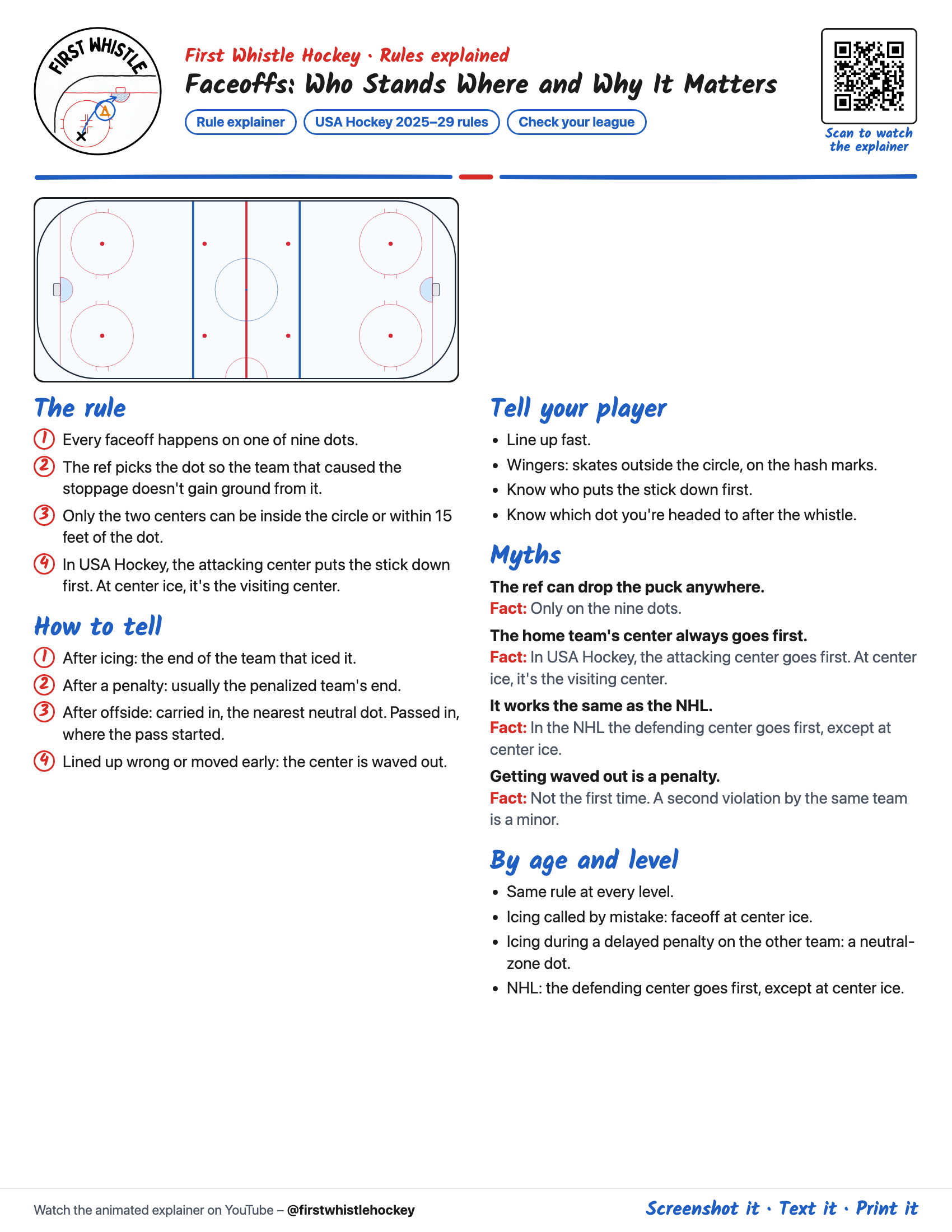
Printable rule sheet
One page, US Letter. Print it for the rink, or save it to your phone and text it to your coaches.
Download the cardVideo transcript
Intro
Every whistle ends with a faceoff on one of nine dots. Here's who stands where, and how the ref picks the dot.
The nine dots
There are nine faceoff spots. One at center ice, four in the neutral zone, and two in each end. The ref picks the dot so the team that caused the stoppage doesn't gain ground from it.
Who stands where
At the faceoff, only the two centers can be inside the circle. Everyone else lines up outside it, behind the hash marks, about a stick length from the player across from them.
Who goes first
Who puts the stick down first? In USA Hockey, it's the attacking team's center, and at center ice it's the visiting center. The NHL flips that: the defending center goes first, except at center ice.
Faceoff violations
Line up wrong or move early, and the ref waves the center out. A teammate takes the draw instead. If the same team does it again, it's a minor penalty.
Which dot
Which dot? After icing, it's in the end of the team that iced it. After a penalty, it's usually in the penalized team's end. And after offside, it depends on how the puck got in.
So tell your player: line up fast, keep your skates outside the circle unless you're taking the draw, and know who goes first. Check your league's rules, and grab the rule sheet in the description.
Rules summarized in our own words from USA Hockey's 2025–29 Official Rules (Rules 612 and 613). Leagues and tournaments can differ, so check yours.
New drills in your inbox
Get new drills, practice plans and printable cards by email. Free, for coaches and parents. Unsubscribe anytime.
First Whistle Hockey (Red Rock Apps LLC) will email you new drills, practice plans and, now and then, news about things we make. We'll send a confirmation email first. Every email has an unsubscribe link. Questions: [email protected]. See privacy.
More rules

Why Your 8U Plays Cross-Ice
Rules explained

Contact vs. Checking: When Does Hitting Start?
Rules explained

The Delayed Penalty: Why Our Goalie Skated Off
Rules explained

Goals That Don't Count (Youth vs. NHL)
Rules explained

Icing: Why the Whistle Blew (and Why There's No Race)
Rules explained

Line Changes: Why Kids Sprint to the Bench
Rules explained

Offside: Watch the Skates, Not the Stick
Rules explained

Penalties 101: Why Is My Kid in the Box, and for How Long?
Rules explained

Respect the Stripes: Zero Tolerance for Players, Coaches and Parents
Rules explained
 Coming soon
Girls' vs Boys' Hockey: What's Different?
Rules explained · Coming soon · Nov 24